
Residential Care vs Nursing Care: What’s the Difference?
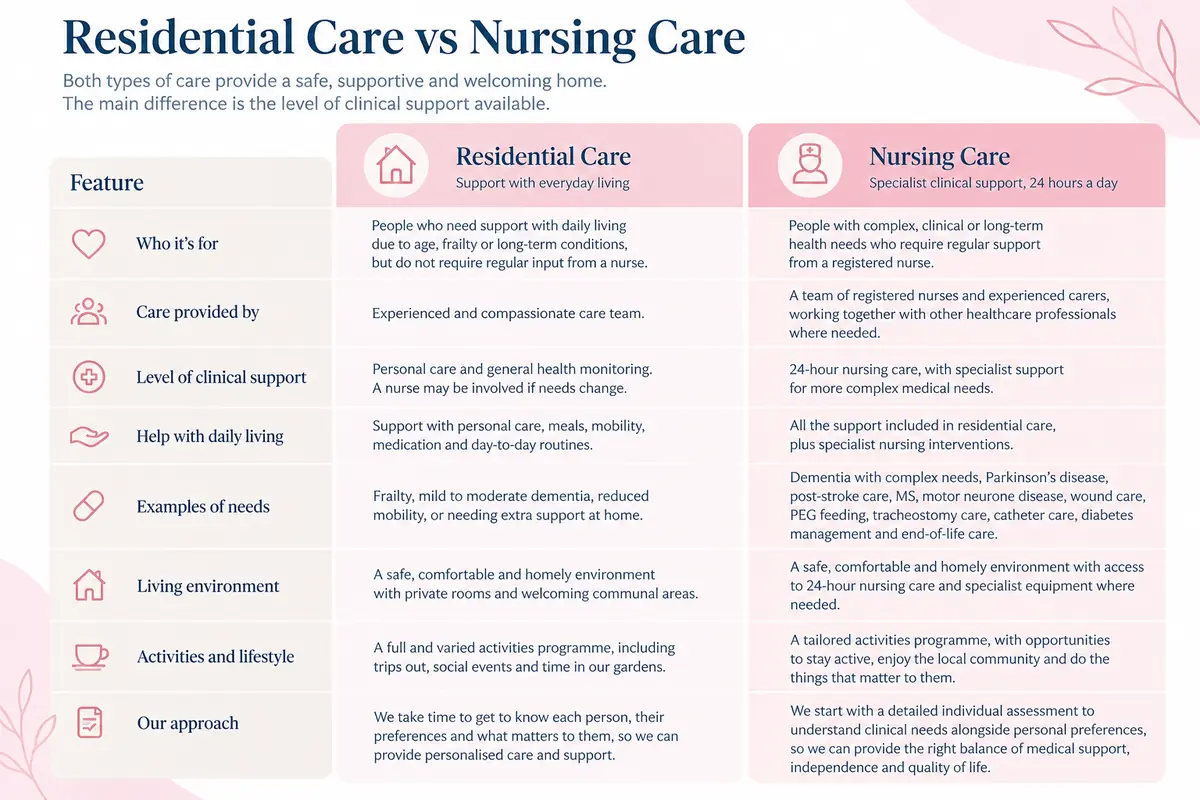
One of the most common questions we hear from people looking at care options is: what is the difference between residential care and nursing care? In our experience, the key distinction is that residential care is carer-led, focusing on personal care, everyday support and wellbeing, while nursing care involves qualified nurses for people who also have clinical needs, such as wound care, PEG feeding or oxygen support.
The right setting always depends on the individual. Someone’s diagnosis alone does not necessarily determine whether they need residential or nursing care, and there can be an overlap between the two. Below, we explain the differences we see in practice, the types of needs each setting can support and how we assess which type of care may be most appropriate.
What is residential care?
Residential care is carer-led. It provides a supportive place to live for someone who may no longer be able to manage safely or comfortably at home but does not require ongoing nursing interventions. At Coast Care Group, every placement starts with getting to know the person and assessing their individual needs. We want to understand what support they need, what they can still do independently, what matters to them in everyday life and what will help them feel comfortable and settled.
Trained care staff are available 24 hours a day and can help with everyday needs including:
- Washing, dressing and personal hygiene
- Eating and drinking
- Medication support in line with an assessed care plan
- Mobility and moving safely
- Using the toilet
- Maintaining familiar routines
- Emotional support and reassurance
- Social activities and companionship
Residential care can support people with a wide range of needs. In our experience, some of the most common include:
Frailty and reduced independence
Sometimes there is no single condition that leads someone to consider a care home. Everyday tasks may simply have become more difficult, tiring or unsafe to manage alone. Residential care can provide the extra help someone needs while still encouraging them to do the things they can for themselves and retain as much independence as possible.
Mobility difficulties
Reduced mobility can make living independently more challenging. Our carers can provide practical support based around the individual’s assessed needs, helping them move safely and remain as active and involved as possible.
Memory loss, Alzheimer’s disease and dementia
A diagnosis of dementia does not automatically mean someone needs nursing care. Many people living with memory loss or Alzheimer’s disease can be well supported within residential care. What matters is how the condition affects that particular person and what support they need throughout the day.
Routine, familiarity, reassurance and getting to know the individual can all be particularly important. Coast Care Group’s own view is that everyone experiences memory loss differently, so there is no one-size-fits-all approach to caring for someone with dementia.
Emotional support and reassurance
Not every care need is physical. Some people need more reassurance, encouragement or companionship to feel comfortable and secure. Building trusted relationships and understanding what helps someone feel at ease can be just as important as practical support. Residential care is therefore about much more than completing everyday tasks. For us, a good care home should help someone continue to enjoy everyday life, maintain their independence wherever possible and feel part of a community.
This reflects our wider approach at Coast Care Group: positive outcomes and a person’s daily lived experience are just as important as the clinical and medical aspects of their care.
At Whitebriars in Bexhill, the team supports people who may need more help with everyday life, including those living with frailty, mobility difficulties or the earlier stages of memory loss. The focus is on providing a safe, reassuring environment while helping residents maintain as much independence and familiarity as possible.
Whitebeach in St Leonards also provides residential care, with particular experience supporting people living with dementia and more advanced memory loss. Care is shaped around the individual, with an emphasis on reassurance, routine, emotional wellbeing and making day-to-day life feel comfortable and meaningful.

What is nursing care?
Nursing care includes much of the same personal care, companionship and everyday support as residential care, but with one important difference: qualified nurses are also part of the care team. This means nursing care can support people whose health needs require regular clinical monitoring, treatment or interventions that cannot be provided by carers alone. Just as importantly, the person remains at the centre of the care – not the condition.
At Coast Care Group, we look at someone’s health, their day-to-day needs, the clinical support they require and what matters to them as a person before deciding whether one of our nursing homes may be appropriate.
Depending on someone’s assessed needs, nursing support may include:
- Wound and pressure-area care
- PEG feeding and care
- Oxygen support
- Catheter and stoma care
- Diabetes and insulin management
- Tracheostomy care
- Syringe drivers
- Support with complex or progressive health conditions
- Palliative and end-of-life nursing care
Some of the needs we commonly associate with nursing care include:
Complex clinical needs
Some people need several different types of support at the same time, or have health needs that require closer clinical oversight. Nursing care allows clinical support to sit alongside personal care, reassurance and the familiar rhythms of everyday life.
Progressive neurological conditions
People living with conditions such as Parkinson’s disease, Huntington’s disease or motor neurone disease (MND) may develop more complex care needs as their condition progresses. That does not mean a diagnosis automatically leads to nursing care; we look at how the condition affects the individual and what clinical support they actually need.
Physical disabilities and complex mobility needs
Some people require nursing care because of a physical disability, spinal injury or significant mobility needs rather than a particular illness. The aim is to provide the right physical and clinical support while helping each person retain choice, independence and involvement in everyday life wherever possible.
Bariatric care
People requiring bariatric care can have a combination of mobility, personal care, equipment and health needs. Where those needs include ongoing clinical care or nursing interventions, a nursing setting may be more appropriate. Suitability is always considered individually.
End-of-life care
Towards the end of someone’s life, needs can become more complex and may change quickly. Nursing support can help manage symptoms, medication and changing clinical needs while the wider team focuses on comfort, dignity and making sure the person feels as settled and supported as possible. Support for family and those close to the person is also an important part of compassionate end-of-life care.
At Whitecliff in St Leonards, our team provides 24-hour nursing care for people with a range of health, neurological and more complex care needs.
Coast Care Centre in Bexhill also provides 24-hour nursing and dementia nursing care, supporting people whose health needs require a greater level of clinical input alongside their everyday care.
Residential care home vs nursing home: what is the main difference?
When we explain the difference to people, one of the most useful questions to ask is: does the person need ongoing clinical care from a qualified nurse? In a residential care home, trained carers provide personal care, practical help, emotional support and assistance with everyday life. In a nursing home, residents receive this day-to-day support alongside care from qualified nurses.
Someone may need considerable help with washing, dressing, mobility, memory loss, reassurance and other aspects of everyday life and still be well supported within residential care. If that person also needs regular wound care, PEG feeding, oxygen support or another clinical intervention requiring nursing expertise, nursing care may be more appropriate.
The difference is therefore not simply how much care someone needs, but what type of care they need.
How do we work out whether someone needs residential or nursing care?
This is another question we hear regularly, and the important thing to know is that you do not need to work this out on your own before speaking to us.
When someone first contacts Coast Care Group, we start with a conversation. We want to understand the person behind the enquiry, not simply see a list of medical conditions.
- What help do they need with everyday life? This can include washing, dressing, eating, medication, mobility and using the toilet.
- Do they have clinical needs? We look at whether they need regular nursing interventions, treatments or clinical monitoring.
- How is their mobility? We consider how safely they can move and what physical assistance or equipment they may require.
- Do they have memory or cognitive difficulties? We look at how memory loss or dementia affects the individual rather than assuming a diagnosis determines the type of home they need.
- What emotional support do they need? Feeling safe, reassured and understood can be just as important as practical care.
- Are their needs likely to change? Progressive conditions can mean care requirements develop over time, so we consider current circumstances alongside what may be needed in the future.
From there, we can discuss which of our homes may be suitable, arrange a viewing and complete an assessment before admission. We can also work alongside multidisciplinary healthcare professionals where necessary to help support a smooth transition into the home.
Not sure which type of care is right?
If you are looking at care for yourself or someone close to you, it is completely understandable if you are not sure whether residential or nursing care is the right starting point. You do not need to make that decision before contacting us. Tell us about the person, what life is like for them at the moment and where they need support. We can talk through their circumstances, answer your questions and arrange an assessment to understand their needs properly.
Where appropriate, you can also visit the home, meet the team and get a feel for everyday life there before making a decision. Ultimately, finding the right care is about more than choosing between two labels. It is about finding somewhere that can meet a person’s needs while helping them feel safe, comfortable, understood and able to enjoy the best possible quality of life.
Book a free care assessment or call 01424 845 543 to speak to the Coast Care Group team.
Frequently asked questions
Is nursing care the same as residential care?
No. Both provide 24-hour support and help with everyday life, but there is an important difference. Residential care is carer-led, while nursing care also has qualified nurses available to support people with clinical needs and nursing interventions.
Does needing a lot of support mean someone needs a nursing home?
No. Someone can need significant help with personal care, mobility, memory loss or emotional wellbeing and still be well supported within residential care. It is usually the type of support needed, rather than simply the amount of support, that helps determine whether nursing care is required.
Can someone with dementia live in a residential care home?
Yes. Many people living with dementia or Alzheimer’s disease can be supported within residential care. We look at the individual rather than their diagnosis. If someone also has clinical needs requiring regular nursing support, a nursing setting may be more appropriate.
Can residential care homes help with medication?
Yes. Trained care staff can provide medication support where this forms part of the person’s assessed care plan and the home’s medicines procedures. Some treatments and clinical interventions need to be provided by appropriately qualified healthcare professionals, which is one of the areas considered when assessing the right type of care.
When might someone need nursing care?
Nursing care may be appropriate when someone needs regular clinical monitoring, treatment or nursing interventions alongside their everyday personal care. This could include wound care, PEG feeding or oxygen support. Some people living with progressive neurological conditions, or those requiring bariatric or end-of-life care, may also need nursing support depending on their individual circumstances.
Does Parkinson’s, Huntington’s disease or MND automatically mean nursing care is needed?
No. These conditions can lead to more complex needs, but every person experiences them differently. We look at how the condition affects the individual and what clinical support they actually require before considering which type of care is appropriate.
What happens if someone’s needs change after moving into a care home?
We continually review residents’ needs and care plans. If someone’s circumstances change, we look at what additional support they may need and whether their current care setting remains appropriate.
How can I find out which type of care is right?
The best place to start is a conversation and care assessment. This gives us the opportunity to understand the person’s health, mobility, personal care, memory, emotional wellbeing and any clinical needs before discussing which type of care and which Coast Care Group home may be appropriate.